
INVESTIGATION: How Jonathan govt. paid companies linked to Doyin Okupe to attack ‘unfriendly’ websites
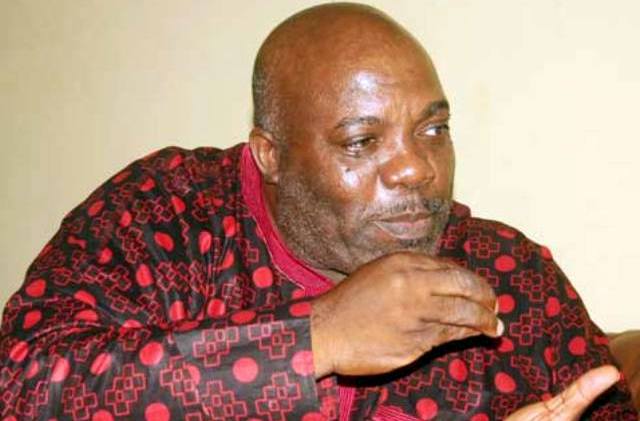
Two companies linked to Doyin Okupe, a former media aide to President
Goodluck Jonathan, got at least N1.6 billion off the former National
Security Adviser, Sambo Dasuki, in three shady cyber security contracts,
PREMIUM TIMES investigations have shown.
One of the contracts had instructions to hunt down unfriendly media websites with Distributed Denial of Service attacks.
It was a project conceived to shut down online media platforms
perceived as friendly to Buhari or critical of Mr. Jonathan ahead of the
2015 election.
The other was a contract to intercept all optic fibre cables landing
in Nigeria. The third was a passive mass and target GSM interception
that had the ability to decrypt ciphers and operate undetected.
Mr. Okupe, a former Senior Special Assistant on Public Affairs to Mr,
Jonathan, has so far evaded scrutiny in the ongoing arms contracting
scandal where the former National Security Adviser, Sambo Dasuki, is
charged for allegedly mismanaging funds meant for the fight against Boko
Haram in Nigeria’s northeast region.
The government believes Mr. Dasuki’s actions led to the death of
thousands of Nigerians and hundreds of Nigerian troops in the hands of
Boko Haram fighters.
The contracts awarded Mr. Okupe’s close allies reinforces claims that
the former NSA merely doled out cash and contracts to cronies and
political associates and violated procurement regulations in the
process.
In the three contracts investigated by PREMIUM TIMES, the NSA did not
prioritize efficiency or due process and value for money in the
awarding process. Rather, there was a pattern of hurried release of
cash. In one instance, full contract sums were paid before delivery of
products – and insiders claim product was never delivered.
In the three contracts, the NSA paid more than double the actual
amounts of items purchased and relied on single source when it could
have opened up the contract to competitive bidding.
Hunting the opposition
On June 13, 2014, in the heat of the 2015 presidential elections
campaigns, Romix Technologies Ltd, registered as an offshore and
anonymous company in Cyprus, received N398 million – two million US
dollars – payment from the Office of the National Security Adviser in
Nigeria.
That was a part payment for a cyber-hooliganism contract that would later cost Nigeria $2.6 million.
The sum was wired to Romix technologies Ltd’s bank account account
held with Luemi Private Bank in Zurich, Switzerland in June 2014.
The contract for which Romix Technologies was paid N398 million was
merely explained as “supply and installation of cyber intelligence
system software at the office of the National Security Adviser.”
The specific software was not stated. But PREMIUM TIMES
investigations revealed that the true nature of the contract was to
acquire tools to carry out Distributed Denial of Service (DDoS) attacks
on websites believed to be critical of Mr. Jonathan, ahead of the
elections.
The actual purchase was a DDoS service called “The Systems” offered
by Packets Technologies AD, an Israeli company operating out of
Bulgaria.
Its job was simple – attack and bring down websites the NSA felt was
not sympathetic to the administration of Goodluck Jonathan. This they
did by flooding target website servers with malicious traffic with the
aim of shutting out genuine visitors and working host servers till they
break down.
Many Nigerian media websites, including PREMIUM TIMES, were victims
of these attacks through the campaign period to the election days.
“On the day of the presidential election in 2015, we suffered a layer
7 – or application layer DDoS – that lasted 23 hours and peaked at 200
Megabytes per second forcing us to deploy extensive measures to remain
online,” PREMIUM TIMES Managing Editor, Musikilu Mojeed, said.
Internet security experts estimate that the amount the NSA paid for
these hacking services was at least 250 percent higher than the actual
market value.
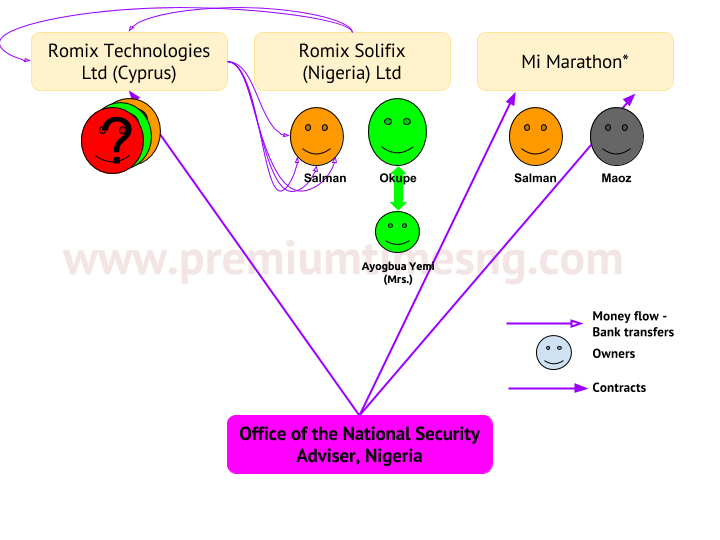
This contract, we believe, was Mr. Okupe’s direct share of the largesse, now known as Dasukigate.
Romix Technologies in Cyprus has its ownership anonymized – a
practice allowed in Cyprus and few other countries that enable
‘investors’ set up and run shell companies.
The company shares its first name and financial ties with Romix
Soilfix Nigeria Ltd, owned by Mr. Okupe and Ilan Salman, an Israeli who
has worked in Nigeria for close to 20 years.
Mr. Okupe denies any links with the company. His partner at Romix in Nigeria, Mr. Salman, does not.
“Romix Technologies is a duplicity of name,” Mr. Okupe told PREMIUM TIMES. “I have nothing to do with it.”
Romix Technologies Ltd is a shell and anonymous company in Cyprus –
which means it can allow its true owners remain anonymous to the public.
But PREMIUM TIMES investigations traced several financial
transactions between the company and its Nigerian version, Soilfix
Nigeria Ltd as far back as 2012 when Mr. Okupe was still an active
member of the board at Romix in Nigeria.
Our investigations also traced financial transactions between Romix
in Cyprus and Mr. Salman, the Israeli who partnered Mr. Okupe to found
Romix Soilfix in Nigeria, back in 2004.
Mr. Okupe claimed Mr. Salman left Romix in Nigeria several years ago and may have set up the shell company in Cyprus.
PREMIUM TIMES investigations showed otherwise. Mr. Salman still sat
on the board of Romix in Nigeria and owned 40 percent of the company’s
shares as at first week of January, this year.
Monies paid to Romix Technologies Ltd was a loss to Nigerians. No tax
was remitted to the Nigerian government in this transaction.
Mr. Salman defended the non payment of taxes, arguing that it was part of the contract term.
“This was an offshore contract,” he said. “Our solution was in (US)dollars, no tax.”
Mr. Salman claims the Nigerian government owes him $600 thousand on this project.
An accounting official at the NSA office, Yazidu Ibrahim, had earlier
testified that “in the last five years, for all the companies that were
paid, VAT and Withholding Tax were never paid for any contract.”
Master Surveillance
Master Surveillance
Mr. Salman runs a second company called Mi Marathon with another
Israeli, Maoz Steinhauer. In the run up to the 2015 elections, Mi
Marathon, grabbed two juicy contracts from the Nigerian government
through the former NSA, Dasuki.
The largest contract was one called Fiber Optic Landing Solution
worth N712.2 million ($3,580,000.00). This contract was meant to create a
backdoor access to all fibre optic cables landing in Nigeria for the
office of the National Security Adviser.
Insiders explained this contract as ‘simply plug into all the optic
fiber cables linking Nigeria so that the NSA can have direct access and
inspect all packets entering or leaving Nigeria’. “Mass surveillance
from the source.”
Papers for this contract was signed in January 2014. Ibikunle
Daramola, a naval Group Captain, who was secretary to the former NSA
signed agreements on January 17, 2014.
But the contract was not completed, insiders said. Mr. Salman blamed this on the NSA.
The third was a N335.1 million (USD1.6 million) contract to supply a
stealth and intrusive GSM mass surveillance called Engage GI2 Tactical
Solution developed by Verint.
M.I. Smart Solutions, a subsidiary of MI Marathon, sent in the
proposal to supply this device in April 2014. By July, the NSA had
approved and payments were made to another company in the Mi Marathon
network, Mimarathon Resources Limited.
Interestingly, rather than approve the contracts before payments were
made, the former NSA directed the Central Bank of Nigeria to pay Mi
Marathon, in United States Dollars, on July 11 while approval for the
contract was documented 10 days later.
The former NSA did not prioritize service delivery and cost effectiveness while awarding this contract.
The NSA awarded these contracts on single proposals, a manipulation
of the procurement process allowed during natural disasters or
emergencies or when procuring services rendered by only one provider.
In transactional documents between the NSA and Mi Marathon, seen by
PREMIUM TIMES, the NSA paid for two units of the Engage GI2 Tactical
Solution at the cost of $841,000 per device. In the end, only one GI2
IMSI Catcher was supplied at the cost of $329,800.
In this deal alone, Mi Marathon made a profit of over $511,200 thousand. Mr. Salman argued his prices were very competitive.
As at the time the NSA doled out cash for these surveillance devices,
the country had little need for them. The NSA had many other systems
like the Elbit’s Wise Technology acquired few years before. Pegasus,
Circles and many other mass surveillance solutions.
Mr. Salman denied he got these contract to help siphon monies to Mr.
Okupe. He explained that the reasons only him got these three juicy
contracts from the NSA in one year was because he is a great marketer.
The office of the National Security Adviser, currently headed by
Babagana Monguno, declined to comment on these contracts. An FOI request
sent to his office was simply ignored.
INVESTIGATION: How Jonathan govt. paid companies linked to Doyin Okupe to attack ‘unfriendly’ websites
![INVESTIGATION: How Jonathan govt. paid companies linked to Doyin Okupe to attack ‘unfriendly’ websites]() Reviewed by Queency
on
20:30:00
Rating:
Reviewed by Queency
on
20:30:00
Rating:


